Scotland
 UK
UK Ireland
 London

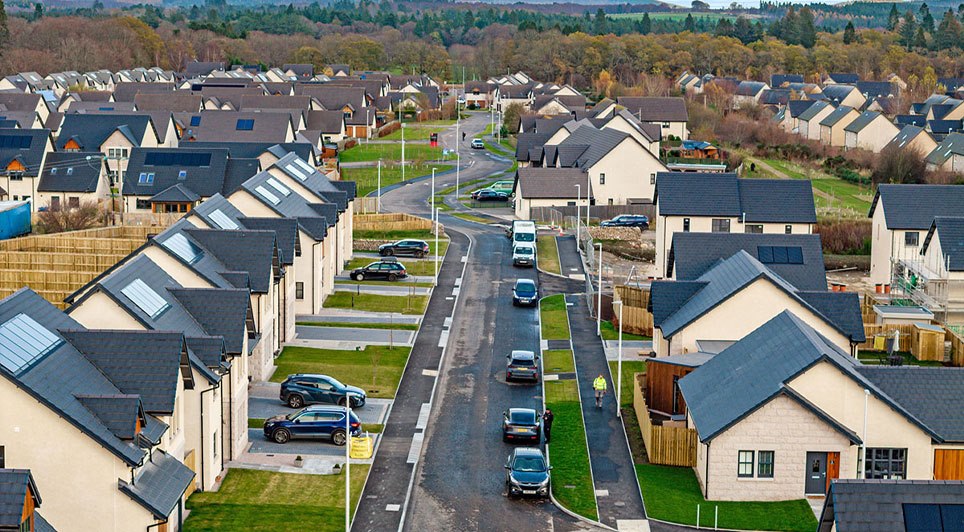
The Future Homes Standard is no longer a distant prospect. For developers, housing associations, local authorities and contractors in England, it is rapidly shaping how new homes are designed, specified and delivered.
Although much of the debate has centred on low‑carbon heating and renewable technologies, genuine compliance begins with the building fabric. The most effective way to deliver energy‑efficient homes is to cut energy demand at source.
This is where timber frame construction makes a decisive difference.
Timber frame has provided high levels of fabric performance, airtightness and build quality for decades—exactly the outcomes now essential as the industry prepares for the Future Homes Standard. While no structural system guarantees compliance on its own, timber frame gives developers a robust platform on which to achieve it.
The Future Homes Standard aims to ensure new homes in England are highly energy efficient and ready for a low‑carbon future. Homes should require far less energy to heat and run, reducing carbon emissions and lowering occupants’ bills.
For the construction sector, that represents a shift in emphasis. Historically, many projects achieved compliance by adding technologies late in the process. Increasingly, the focus is on a fabric‑first approach—designing the building to perform efficiently before layering on additional systems. Timber frame offers clear strengths in this area.

Precision‑manufactured, offsite timber frame systems produced in controlled factory conditions deliver greater consistency and quality control than many traditional methods. This supports high levels of insulation performance and airtightness while reducing the variability often seen with purely site‑based construction.
In the private housing market, developers want practical ways to future‑proof their product, hold programme certainty and manage build costs. Timber frame enables high‑performance homes without fundamentally changing how schemes are delivered.
For affordable housing providers, the challenge can be even greater. Housing associations and local authorities must balance strict performance requirements with tight budgets and ambitious delivery targets. As funding criteria and sustainability expectations evolve, timber frame provides a proven route that supports programme efficiency and long‑term operational performance.
The same logic applies to build‑to‑rent, student accommodation and mixed‑tenure projects, where operational energy performance is an increasingly important factor for investors, operators and residents.
The Future Homes Standard also lands at a time of wider industry pressures around skills shortages, labour availability and programme delivery.
Developers face growing demands to build more homes, more quickly, while maintaining quality and meeting rising performance thresholds. Offsite manufacturing helps by moving key construction stages into a controlled factory environment, reducing reliance on site labour and improving consistency across schemes.
At Deeside Timberframe, we have seen first‑hand how early engagement helps developers unlock these benefits.
The greatest value is achieved when timber frame is integrated from the outset. Through Design for Manufacture and Assembly (DfMA) principles, structural layouts can be optimised, material use streamlined and construction programmes coordinated around offsite delivery. This supports energy performance goals, reduces risk, improves programme certainty and enhances overall project viability.
As the Future Homes Standard draws nearer, the question should not be how to secure compliance at the end of a project, but how to design homes that perform from day one. Timber frame is not a new answer to that challenge—it is a proven one.
To discuss a project, email [email protected] or call 01569 767 123.