Scotland
 UK
UK Ireland
 London

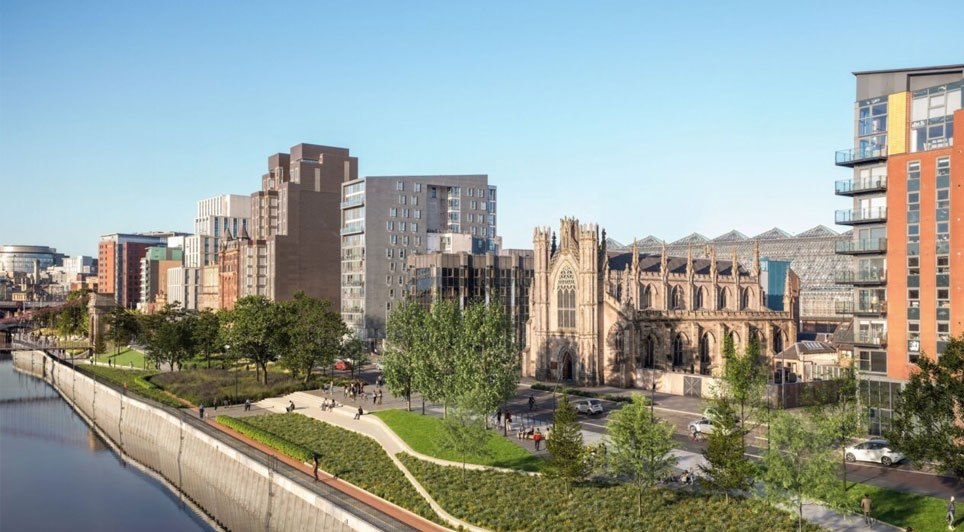
Glasgow City Council has approved a scheme spanning more than seven hectares across both banks of the River Clyde, introducing new public spaces, walking and cycling routes, play areas and event spaces between Glasgow Bridge and Victoria Bridge.
The masterplan is being led by Hawkins\Brown, with Civic providing civil and structural engineering alongside stakeholder engagement and communications support. The project brings together engineering, movement, public realm, biodiversity, heritage and environmental considerations to create a more connected waterfront.
A more accessible river edge is proposed, with enhanced public realm and green space to reconnect the city centre to the Clyde. At Carlton Place, the existing open space will be renewed as an inclusive urban park, while the wider site will offer places to walk, cycle, meet and spend time beside the river.
Isla Jackson, Director and Head of Civic's Scotland studio, said: "Securing planning permission feels like a really important moment for the project. There's been a lot of work behind the scenes over the last few years, and a lot of different people and perspectives involved. What makes this one particularly interesting is that it's not just about solving some pretty complex engineering challenges – it's about thinking differently about how this part of Glasgow connects with the Clyde.

"I'm really looking forward to seeing more green space and somewhere for people to spend time by the river. It'll be great to see how it starts to come to life over the next year."
Nikki Johnston, Associate at Civic, said: "What's interesting about this project is how much has to work together. You've got the new quay wall and drainage infrastructure, but then you're also thinking about how people move through the space, where they stop and spend time, and how all of that relates to the river. The hope is that the waterfront feels easier to get to, easier to move around and somewhere people actually want to spend time."
The scheme has been shaped by extensive engagement with people who live, work and spend time along the waterfront.
Becca Thomas, Director of Place at New Practice, part of Civic, said: "A big part of the project has been listening to the people who already know and use this part of Glasgow. We've had surveys, site walks, workshops, public events and youth engagement, as well as working with local social enterprises and artists.
"That's given us a much better understanding of what the waterfront means to people now, and what they'd like it to become in the future. It's helped make sure the plans aren't just designing a space, but responding to the people and communities around it."
The proposals create opportunities to tackle wider environmental and infrastructure needs: surface water outfalls can be incorporated into the new quay wall to support Glasgow's broader drainage strategy, while blue–green infrastructure and additional green space are intended to enhance flood resilience, biodiversity and the overall waterfront experience.
Heritage is central to the approach. The site sits next to the Grade A-listed Custom House and includes existing features that speak to the waterfront's history. The design explores retaining, refurbishing or relocating heritage elements to enrich the stories connected to the area.
Ultimately, the project aims to do more than renew a quay wall or lay out a park; it seeks to reconnect Glasgow with one of its defining natural assets and create a waterfront that supports everyday life, activity and connection for surrounding communities.
With consent in place and construction anticipated to start in 2027, the focus now shifts to delivery—turning the vision into a place better for people, planet and place.