Scotland
 UK
UK Ireland
 London

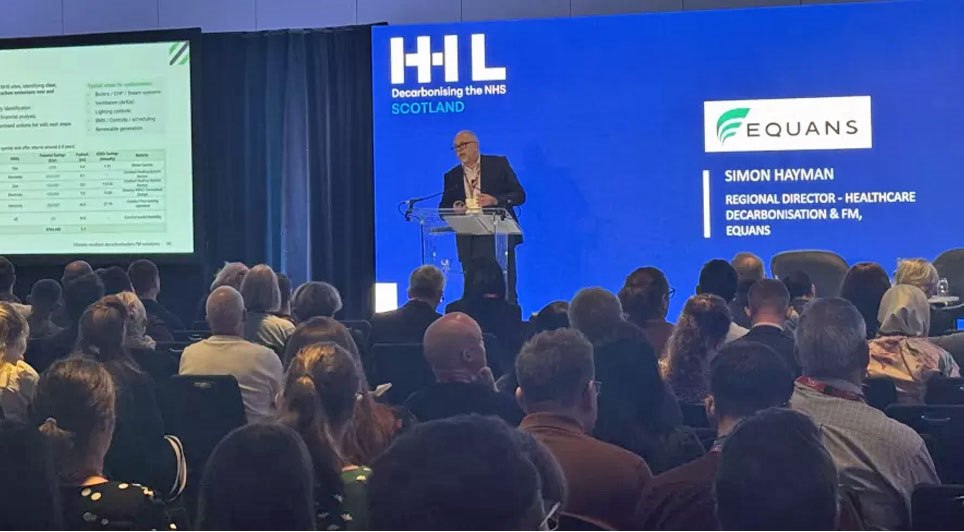
The condition of Scotland's healthcare estate directly influences the quality, reliability and efficiency of care. Hospitals and other clinical settings run around the clock, often in ageing buildings with constrained infrastructure. Decarbonisation should not sit apart as a purely environmental initiative; done well, it can improve resilience, air quality and comfort, ease pressure on estates teams and support healthier communities.
The central challenge is to reduce emissions while maintaining modern clinical standards and continuity of services. Meeting this test demands more than new technology. Health Boards need sustained investment, realistic delivery plans and a clear view of how each intervention will boost efficiency, strengthen resilience and enhance the care environment.
1. Decarbonisation as an operational priority
For Scotland's Health Boards, decarbonisation is a live operational priority. Estates teams must balance energy performance alongside infection control, ventilation, temperature, clinical availability and the reliability of critical systems. Every change must be planned around patient needs.
Approaches will differ by site. A large urban hospital faces different constraints to a rural or remote facility. Some buildings may be ready for early electrification; others will require a phased path, first lowering energy demand before replacing plant, adding local generation and storage, or connecting to heat networks.
Funding remains pivotal. The case for investment is strongest when it links lower emissions to reduced running costs, less exposure to energy price volatility and improvements to the clinical environment. Decisions should be based on whole-life value rather than lowest upfront cost, and should factor in climate risks such as flooding, wildfires and extreme heat, as well as potential disruption to transport, utilities and local services.

2. A five-stage route from planning to delivery
Stages 1–3: understand the estate and lift current performance. Health Boards first need a dependable picture of estate performance, drawing together energy and carbon data, asset condition, maintenance records, building controls, space utilisation and climate risk. Data alone is insufficient: clinical, facilities and operational teams can pinpoint critical areas, patient priorities and the practical limits on shutdowns or service changes. Early gains typically come from optimising controls and schedules, improving metering, fault detection and maintenance—cutting waste, improving reliability and building evidence for capital investment.
Stages 4–5: prioritise investment and deliver. Potential projects should be evaluated against carbon reduction, whole-life cost, operational savings, resilience, clinical impact and delivery complexity. This supports a phased programme based on need and value rather than a shopping list of technologies. Delivery must be choreographed around care—using planned shutdowns, temporary systems and tight coordination with clinical and facilities teams. Commissioning and ongoing performance monitoring should verify benefits and inform the next wave of work.
3. Embedding climate resilience in every business case
Decarbonisation and climate adaptation must be planned together. Cutting emissions matters, but facilities also need to operate safely during extreme heat, flooding, severe weather and wider infrastructure disruption. Every business case should assess climate risks, including cooling needs, surface-water management, security of power and water, protection of critical plant, and the reliability of oxygen, ventilation and essential supplies. Access to sites and supply-chain continuity during severe weather also need consideration. Addressing these issues early helps avoid unintended consequences and safeguards patient care over the asset's life.
4. Turning estate data into practical action
Digital tools should enable better decisions, not become standalone technology projects. Integrating building management systems, maintenance platforms, meters, sensors and asset records can give estates and clinical teams clearer visibility of performance. Used well, this helps identify faults earlier, plan maintenance, reduce downtime and cut wasted energy. It can also demonstrate whether changes are delivering steadier temperatures, improved air quality and more reliable services. The value lies in using data to act—rather than in the volume of data collected.
5. Making the investment case
A robust business case looks beyond carbon savings. Health Boards should weigh energy and operating costs, asset renewal, climate resilience, compliance, safety and the experience of patients and staff. This clarifies how estate investment underpins care delivery and allows options to be compared against the outcomes that matter most. Whole-life affordability should be central: lower energy use, reduced maintenance and fewer unplanned failures all strengthen the case for action.
Taken together, these steps turn decarbonisation into a long-term programme to upgrade the healthcare estate—not only to reduce emissions, but to create facilities that are more efficient, reliable and resilient, and better able to support patient care.