Scotland
 UK
UK Ireland
 London

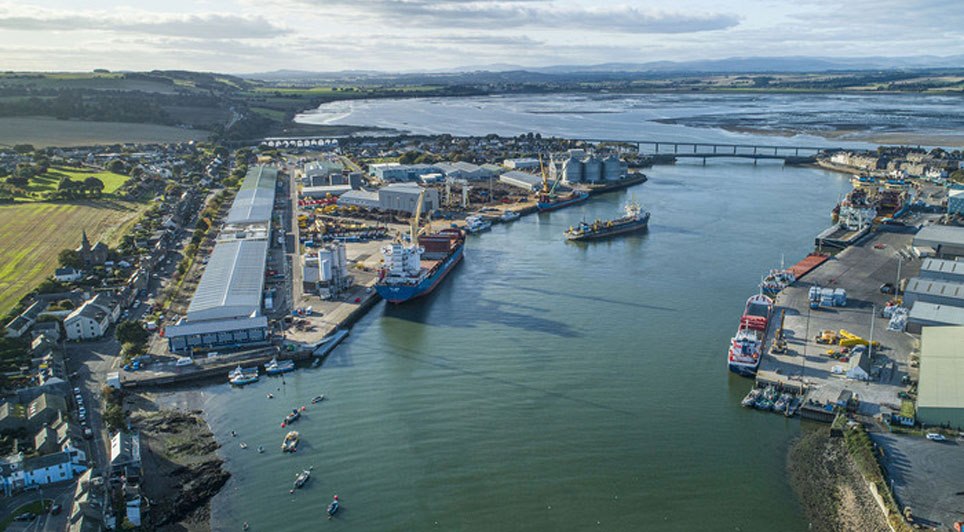
Scotland's ports could become major hubs for clean electricity demand, catalysing offshore wind manufacturing and shore power, but will require coordinated planning and timely grid investment, according to a new report commissioned by Scottish Renewables and published by specialist grid connections consultancy Roadnight Taylor.
Port Power – Electricity Demand in Scotland assesses how ports' electricity requirements are evolving as they support offshore wind manufacturing and assembly, wider industrial electrification and the decarbonisation of maritime activity.
Ports across the country have already committed significant capital to attract clean energy projects and to strengthen Scotland's offshore wind supply chain, with recent developments at Montrose Port among the latest examples. Onshore manufacturing, assembly, operations and maintenance can deliver greater economic value, while shore power can cut emissions and improve local air quality by enabling vessels to plug into electricity while alongside.
However, grid bottlenecks, consenting delays and high power costs risk slowing progress and stranding investment. Scottish Renewables is urging policymakers to ensure port demand informs the Strategic Spatial Energy Plan (SSEP) and Regional Energy Strategic Plans (RESPs), enabling faster consents and better coordinated network upgrades.
Drawing on interviews with representatives from 12 Scottish ports and harbours, the report highlights the following:
- Ports have diverse electricity profiles: needs range from modest capacity increases for existing operations to substantial new demand driven by prospective tenants. Treating ports as a single, uniform demand category is inappropriate.
- Industrial growth is the main demand driver: the largest loads typically stem from onshore, tenant-led projects, with offshore wind manufacturing and assembly prominent among them.

- Investment and consents are out of sync: ports have upgraded infrastructure and capabilities, but delays in approving new grid and offshore wind projects risk delaying or stranding those investments.
- The business case for shore power needs strengthening: constrained network capacity, upfront costs, electricity prices and uncertain vessel demand are suppressing uptake.
To address these challenges, the report recommends action across planning, regulation and delivery:
- Embed ports in strategic energy planning: ensure SSEP, RESPs and network plans reflect the source, certainty, scale and timing of port demand.
- Accelerate grid consents and connections: establish clearer application routes, remove avoidable decision delays and improve access to queue data and guidance for customers.
- Improve coordination and cost certainty: clarify responsibilities across government and regulators, increase transparency on connection costs and explore flexible solutions where capacity is tight.
- Recognise how port investment operates: connection reforms should allow ports to secure credible capacity ahead of final tenant commitments and financing.
Angela Hepworth, CEO of Scottish Renewables, said: "Scotland's ports and harbours have already invested substantially in the infrastructure and capability needed to deliver our offshore wind potential. Consenting delays now risk holding back manufacturing investment and skilled jobs in coastal communities.
"Ports need secure electricity capacity to attract manufacturers and build on investment already made. National and regional energy plans must accelerate grid consents, coordinate network investment and provide greater certainty on connections.
"Getting this right will help ports secure new industrial investment and expand shore power, helping to reduce emissions and improve local air quality. Government and industry partners must move quickly to give Scotland's ports the power they need to seize this generational opportunity."
Kyle Murchie, Specialist Connections Engineer at Roadnight Taylor, added: "Many of Scotland's ports have ambitions that rely, in large part, on something less visible than traditional quaysides and cranes. That's access to electricity. His Majesty The King's recent visit to Peterhead Port drawn welcome attention to the role ports can play in Scotland's energy future, at a time when the connections landscape is evolving rapidly and securing new capacity can be challenging.
"What struck us most was that no two of the 12 ports and harbours we spoke with shared the same needs. Some were seeking modest increases for existing operations, while others were planning for projects that could require a step change in capacity. Many of those ambitions centre on 2030, yet with a change in the connections landscape the time to power is uncertain and complex. Many ambitions are also central to the delivery of other new energy projects, hence ports are central to the green economy.
"We're grateful to Scottish Renewables for the opportunity to carry out this research, and to the ports and harbours who shared their plans with us so openly. We hope this evidence might just help ports, other stakeholders, network companies, government and regulators plan next steps together."