Scotland
 UK
UK Ireland
 London

BE-ST's fully funded Low Carbon Passport training, backed by the CITB Industry Impact Fund and led by Balfour Beatty with sector partners, has surpassed 1,000 learners and is down to its final 200 places as it targets 1,200 by the end of 2026.
Built Environment – Smarter Transformation (BE-ST) has marked a major milestone, confirming that more than 1,000 people have now completed its Low Carbon Passport, which equips construction professionals across the UK with the practical skills to deliver low-energy, high-quality buildings.
The programme is supported through the CITB Industry Impact Fund, led by Tier 1 contractor Balfour Beatty, and developed with Morrison Construction, Kier Construction, Robertson Group, Coaction and The Passivhaus Trust. It set out to train 1,200 construction workers by 2026 and, with just 200 places left, has moved into its final phase.
BE-ST says the achievement reflects rising demand for practical, high-calibre training that improves building performance and accelerates the transition to net zero.
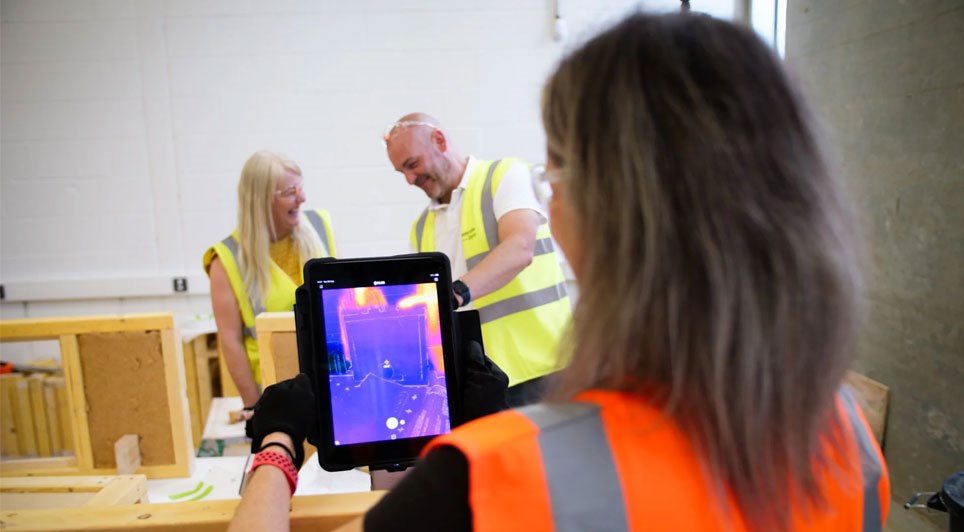
Low Carbon Passport offers free, multi-modal learning that blends flexible online modules with an innovative, hands-on practical session. It focuses on energy efficiency, build quality and the factors that influence real-world performance, helping to close the gap between design and delivery.
Delivered with colleges across Scotland and Northern England, the training has attracted a broad mix of participants including site operatives, apprentices, supervisors, housing professionals, educators, contractors and manufacturers—underlining that better-performing buildings rely on knowledge and collaboration across the whole supply chain.

The initiative has also scaled through a train-the-trainer approach, enabling colleges to embed the content into their curricula and build a lasting skills legacy. Delivery now includes partners such as City of Glasgow College in Glasgow, Inverness College (UHI) and the New Model Institute for Technology and Engineering (NMITE), extending the programme's reach across the UK.
With only nine practical sessions remaining, places are still available at City of Glasgow College, NMITE and the Energy Transition Skills Hub before the programme hits its 1,200-learner target.
Kirsty Duncan, Associate Director of Skills Infrastructure at BE-ST, said: "Reaching 1,000 learners is a significant milestone, but more importantly it shows the appetite across the industry to develop the skills needed to deliver better-performing buildings.
"We've seen learners from right across the built environment take part, reflecting the fact that delivering low-carbon, high-quality buildings depends on everyone understanding the principles of building performance.
"We're particularly proud that the programme is creating a lasting legacy. Alongside delivering training ourselves across the UK, we've worked with colleges through a train-the-trainer approach so they can embed the learning into their own curriculum. With organisations including NMITE and City of Glasgow College now delivering the programme, we're helping build long-term capacity to equip both today's workforce and the next generation with the skills needed for a low-carbon future."
The Low Carbon Passport is fully funded and free to access until December 2026. Its online and in-person training covers insulation, airtightness, moisture management, thermal bridging, building services and construction quality.
Remaining practical sessions will take place at City of Glasgow College, NMITE and the Energy Transition Skills Hub, with approximately 200 learner places still available before the programme concludes.
Attendees at BE-ST Fest 2026 will also be able to join 'Inside the Rig: Lessons from Low Carbon Passport', a practical, collaborative workshop exploring how hands-on learning supports better low-energy construction for students, educators and industry professionals.
Registrations for BE-ST Fest 2026 and the Low Carbon Passport are open, with places available free of charge.