Scotland
 UK
UK Ireland
 London

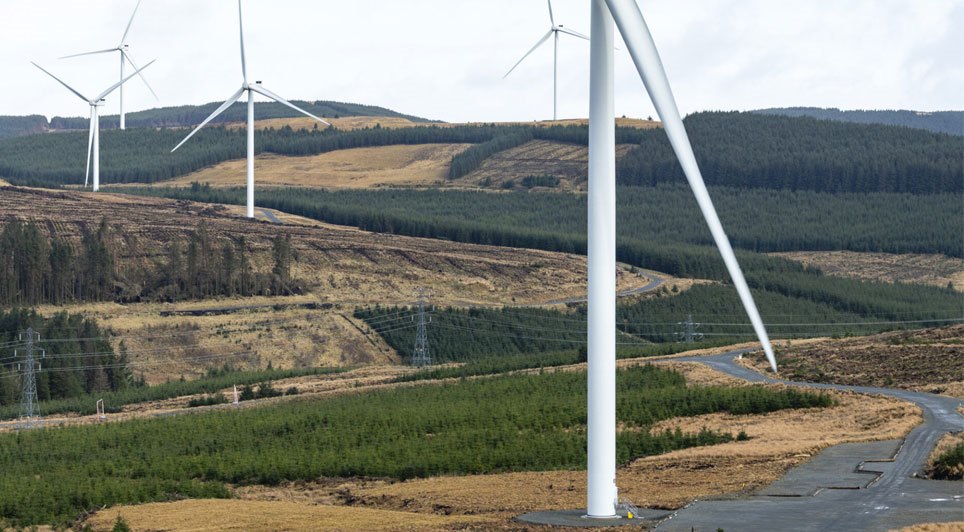
Managing and restoring peat has been one of the most complex tasks at RWE's Golticlay Wind Farm in Scotland, which is being delivered by Farrans. Peatlands are crucial for locking up carbon and supporting biodiversity, making their protection central to the design and construction of renewable infrastructure.
Recognising the site's sensitivity, Farrans collaborated closely with client and wind farm owner RWE during the early stages and through the PCSA phase to produce a comprehensive Peat Management Plan (PMP). The PMP set out how peat would be excavated, handled, stored and reinstated in line with environmental rules and best-practice guidance. It was consulted on and reviewed by key stakeholders, including NatureScot and Peatland Action, before approval. All excavated peat has been kept on site.
An innovative technique was adopted to integrate excavated peat directly into peatland restoration activities, providing a new, sustainable way to valorise the resource on wind farm projects. The objective is to restore degraded peatland next to wind farm infrastructure on formerly forested land.
The method blends excavated peat into traditional ground-smoothing to raise the local water table and create hydrological conditions that encourage peat-forming vegetation and re-functionalise the placed peat. It also cuts handling and storage time, limiting environmental impacts such as peat drying when left for extended periods.

This full-scale trial builds on promising pilot work at Camster 2 Wind Farm by RWE in partnership with FLS and supported by Farrans. The lessons learned informed and refined the approach now deployed at Golticlay. In parallel, RWE and the University of the Highlands and Islands (UHI) are working through a Knowledge Transfer Partnership (KTP), with a grant-funded KTP Associate carrying out detailed monitoring of both pilot and full-scale trial areas. If successful, the technique will be further improved and could see broader industry uptake to enhance excavated peat management and restoration outcomes.
Locations for the technique were chosen after assessing topography and hydrology to prioritise zones where peat would remain saturated. The process involves stripping and retaining existing turves, treating tree stumps to break up ridge-and-furrow patterns, infilling with freshly excavated peat and then replacing the turves over the area.
"Area 7" is the largest full-scale trial zone on site, covering roughly 43,000m2. Approximately 40,000m3 of peat was placed here alone, accounting for a substantial share of the site's total excavated volume.
To move peat efficiently to restoration areas, temporary spur roads were built so trucks could operate beyond the main access routes. After placement, the saved turves were carefully set out and graded to speed up regeneration and protect the site's native vegetation. Reusing turves is a key element of the technique, helping ensure valuable peatland plants are retained and can re-establish where hydrological conditions are suitable.
Delivering the approach at this scale required specialist skills and experience. Expert excavator operators with deep-peat know-how have been pivotal, and earthworks have been led largely by subcontractor Gow Groundworks.
The Golticlay trial shows how robust planning, partnership and technical capability can enable major renewable projects while safeguarding sensitive habitats. Construction at the wind farm is progressing well, with the first blades recently arriving on site and turbine erection due to begin later this summer. Watch the video: youtu.be/midMAS4zqVI