Scotland
 UK
UK Ireland
 London

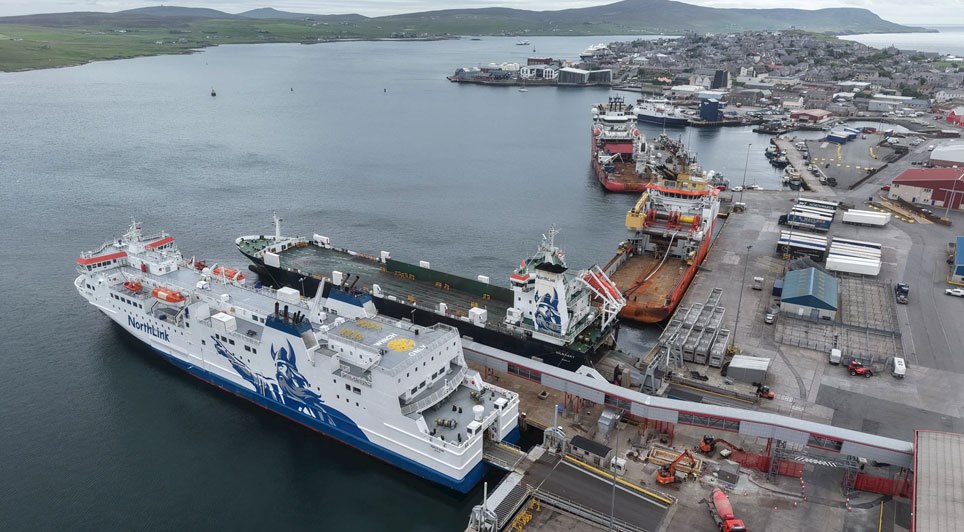
Lerwick Harbour is advancing its role as a leading Scottish port for shoreside electricity with a scheme that will allow NorthLink passenger vessels to connect to the grid during calls at Lerwick.
Developed by Lerwick Port Authority in partnership with Caledonian Maritime Assets Limited (CMAL), the installation at Holmsgarth Berth 3 will supply power to NorthLink vessels at berth and is designed to accommodate future fleet requirements.
The initiative supports cleaner vessel operations and contributes to wider maritime decarbonisation objectives. Earlier this year, contracts were awarded to Frank L Johnston (Shetland) Ltd and ABB Marine & Ports UK to carry out the civil, mechanical and electrical works. Arch Henderson, a company of Haskoning, is leading the design and construction. Civil engineering is under way, with ABB due on site later this year to complete design, installation, commissioning and testing of the system.
Kevin Hobbs, Chief Executive Officer, CMAL, said: "The full funding package for the installation of the shore power project has been provided by CMAL and Transport Scotland as part of its wide-ranging initiatives to reduce the carbon footprint and associated emissions whilst alongside. This initiative will substantially reduce emissions whilst alongside at Lerwick and preparations are being made within this funding package to complete the civil engineering works to extend the shore power provision the new Freight Flex Ferries once delivered."

Once live, the connection will let vessels shut down onboard generators and draw electricity from the harbour network. Demand for shore power at Lerwick has grown steadily; at Mair's Pier alone, high-capacity links have delivered nearly 9 gigawatt hours since commissioning, with average annual consumption of around 1.7 gigawatt hours in recent years.
Capt. Calum Grains, Chief Executive, Lerwick Port Authority, said: "This project represents another important step in the development of Lerwick Harbour's shore power capabilities and reflects our commitment to supporting infrastructure that serves the future needs of our customers.
We have seen significant growth in the use of shore power across the harbour in recent years and this latest development will expand that capability further, while supporting decarbonisation across port operations, transitioning to a low-carbon future and achieving Net Zero aims.
Working closely with CMAL and our project partners, we are ensuring Lerwick remains at the forefront of shore power provision in Scotland and is well positioned to support both existing and future generations of vessels."
Keith Pillay, Local Division Manager UK, ABB Marine & Ports Division, said: "We are proud to partner with Lerwick Port Authority and CMAL on this important shore power infrastructure project. This investment demonstrates the port's commitment to decarbonising maritime operations and supporting sustainable vessel transitions. ABB expertise in designing and installing advanced shore power systems positions us to deliver a reliable, efficient solution that enables vessels to reduce their carbon footprint while operating at berth. Projects like this reinforce Scotland's leadership in clean maritime infrastructure and align with the industry's Net Zero ambitions. We look forward to delivering a first-class system that will serve Lerwick Harbour for years to come."
Stuart Garrett, Managing Director, Serco NorthLink Ferries Ltd, said: "Following four successful years of utilising shore power in Stromness, and with the Aberdeen system at Jamieson's Quay up and running since early 2026, we welcome this additional collaborative initiative between Lerwick Port Authority and CMAL. Plugging into the Lerwick scheme means our overnight vessels sailing between Aberdeen and Lerwick can now use clean electrical power on both sides of their crossing. Turning off our engines in port significantly cuts emissions and noise, immediately improving air quality for terminal users and the community while delivering on our sustainability commitments and meeting passenger demand for greener, lower-carbon travel."
From contract award, the programme is expected to run for about 14 months, including approximately three and a half months of civil works.