Scotland
 UK
UK Ireland
 London

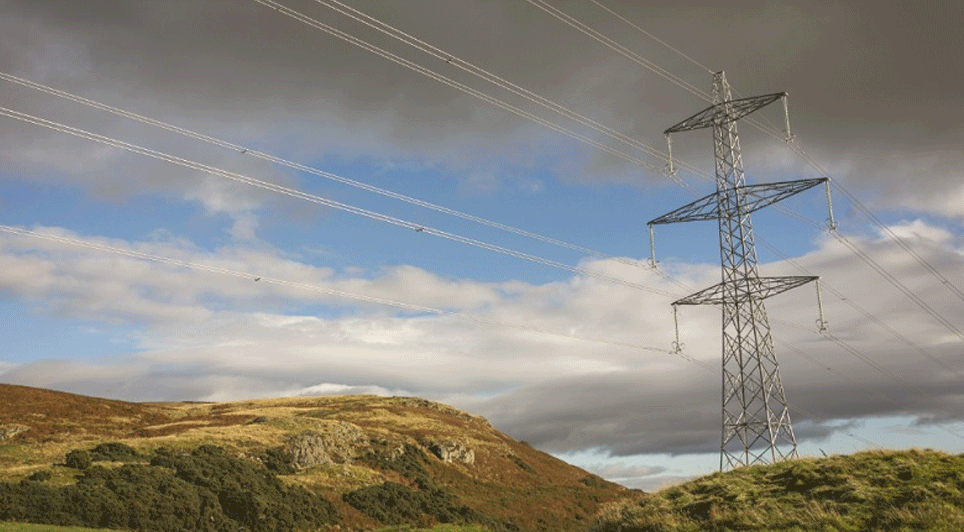
The UK Government has revealed plans to spend £730 million each year on supporting renewable electricity projects until the end of Parliament.
In an announcement today, 09 November, the Department for Business, Energy & Industrial Strategy (BEIS) set out proposals for the next Contracts for Difference auction, which will see companies competing for the first £290m worth of deals for renewable electricity projects.
It is anticipated the auction will see enough renewable electricity generated to power around one million homes and reduce carbon emissions by 2.5 million tonnes per year from 2021/22 onwards.
In addition, consultations will be held on plans to end unabated coal power generation by 2025, which was first announced by the Government in November last year.
Energy Secretary Greg Clark said the announcement was "sending a clear signal" that Britain is the one of the best places to invest in clean energy.
"This is a key part of our upcoming Industrial Strategy, which will provide companies with the further support they need to innovate as we build a diverse energy system fit for the 21st century that is reliable while keeping bills down for our families and businesses," he said.

Elsewhere, a consultation will be launched on whether to treat onshore wind projects on remote islands differently from onshore wind projects on mainland Great Britain.
Industry body Scottish Renewables has said developers and communities on the Scottish remote islands "will be bitterly disappointed" at this decision, which delays Island developers from competing for long-term renewable energy contracts.
Niall Stuart, Chief Executive of Scottish Renewables, said: "After years of work on this issue, and many ministerial pledges to resolve it, we still seem no further forward to unlocking investment on Scotland's islands – home to some of the best wind, wave and tidal resources in Europe.
"With more than 800MW of renewable capacity consented and ready to deliver and a significant capital spend going to UK-based suppliers, the island projects not only serve as important contributions to the Scottish and UK renewable energy targets but to our economy as well.
"But they can only go ahead with contracts to underpin investment and to help meet the prohibitive costs associated with connecting the islands to the national grid."
In addition, no budget has been ring-fenced for marine energy projects in the wave and tidal sectors.
"The wave and tidal sectors are still at an incredibly early stage in their development, and simply not ready to compete with offshore wind on cost alone," Mr Stuart continued.
"If we want to continue the development of the UK's world-leading wave and tidal sectors then we now need government to look at how it will support the development and roll out of the technology to get it to the stage where it can compete in the future."
In conclusion, Mr Stewart said the Government's decision not to launch an auction for onshore wind and solar "makes no sense" as their own research reveals these sectors to be "the cheapest forms of electricity generation in the UK by the middle of the next decade".
"Both could make a significant contribution to meeting our future climate change targets, keeping bills down for consumers and to driving industrial activity here in the UK. But instead, they are being left in limbo, amongst the only forms of electricity generation in the UK unable to access any contractual framework to support long-term investment," he said.
(LM)