Scotland
 UK
UK Ireland
 London

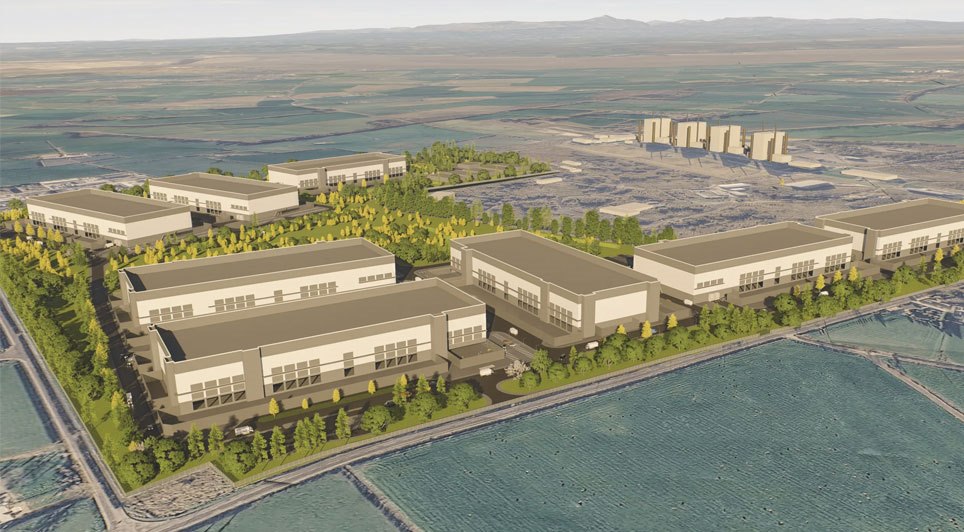
CX Tech Limited has submitted a Planning Permission in Principle (PPiP) application to transform the former Chapelcross nuclear power station site near Annan, Dumfries and Galloway, into the CX Technology Campus.
The outline proposals set out a net zero operational technology campus featuring eight data centres, a dedicated training centre and supporting infrastructure. The scheme represents a prospective investment of about £16.5 billion.
The plan allows for around 1GW of data centre capacity. PPiP is sought for up to 162,000 square metres of data centre floorspace across eight buildings, each designed for approximately 120MW, alongside a training facility. Energy-efficient buildings, sustainable drainage and landscaping are included. As an in-principle application, it would establish the planning framework, with detailed design, commercial, planning and investment decisions to follow.
The campus is intended to operate at net zero in line with the UK Green Building Council framework. The site sits next to a 132kV Grid Supply Point, with approximately 1GW of consented or planned renewable generation identified within 5km and around 2GW within 20km. Backup generation would be fossil-free and used only during exceptional interruptions and routine testing. Embodied carbon during construction would be managed through a Construction Environmental Management Plan, while operational emissions would be minimised via renewable energy and high-efficiency design.

An Environmental Impact Assessment has been completed, with technical submissions covering transport, noise and vibration, air quality, biodiversity, landscape and visual effects, cultural heritage and archaeology, the water environment, soil and groundwater, socio-economics, climate change and greenhouse gas emissions, and human health.
Cooling would use a closed-loop, non-evaporative air system to avoid the continuous evaporative water demand seen in some large-scale facilities. Operational water use is expected to be equivalent to about four houses per data centre per year, or 32 households across the full campus.
Noise at the nearest properties has been assessed to remain below 10 dB over existing background levels. The application seeks consent for data centre buildings up to a maximum height of 40 metres. The local climate would allow extensive use of free-air cooling.
Existing trees and hedgerows would be retained where possible and supplemented with new planting. Additional landscaping is proposed to help the scheme integrate with its surroundings. Sustainable drainage features such as basins, swales and wetland areas form part of the plan, with measures intended to enhance on-site habitats and biodiversity.
The Transport Assessment concludes that traffic generated by the development could be accommodated on the local and strategic road network. A Framework Travel Plan would promote more sustainable travel, including a proposed shuttle bus linking the campus to bus and rail services in Annan.
The development is expected to bring significant economic benefits: an investment of around £16.5 billion, an indicative Rateable Value in the region of £15 million, and—at current 2026/27 Scottish non-domestic rates—around £8.2 million in gross annual business rates. The build phase is forecast to support approximately 750 construction jobs over eight years and provide 40 local apprenticeships each year. Once operational, the campus is projected to create about 450 permanent direct roles alongside wider supply-chain opportunities. A dedicated training centre would open pathways into digital, engineering, energy and low-carbon careers.
Delivery is planned over an eight-year period, enabling infrastructure and capacity to be built in step with operator requirements.