Scotland
 UK
UK Ireland
 London

Pulpex Limited, a sustainable packaging technology company, has announced a £62 million Series D investment round. The funding includes £10 million from the Scottish National Investment Bank, £43.5 million from the National Wealth Fund (NWF), and the remainder from existing investors.
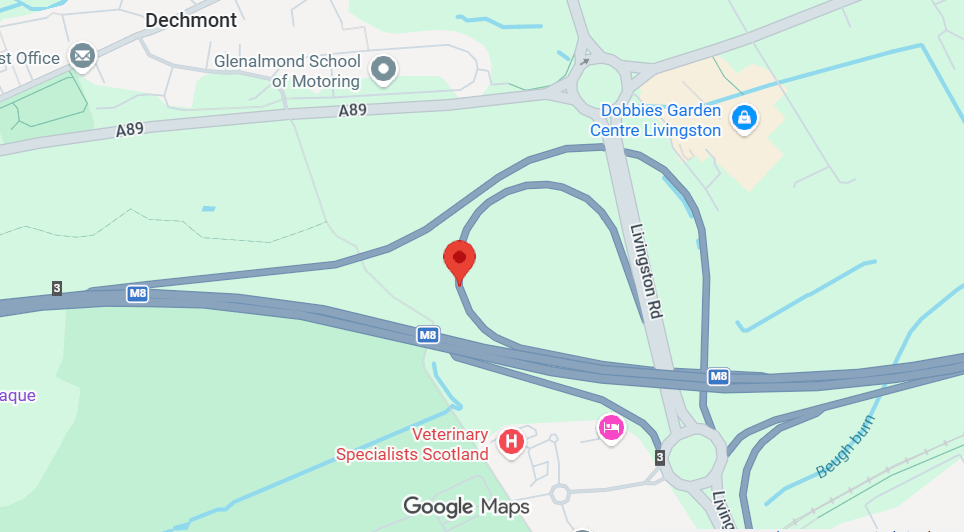
The investment will finance the construction of Pulpex's first commercial-scale manufacturing facility near Glasgow. The planned facility will have a production capacity of 50 million bottles per year and will create 35 new jobs.
Pulpex has developed a fibre-based bottle solution made from sustainably sourced wood pulp, free from hidden plastics. The bottles are designed to be recycled alongside paper and cardboard in standard household recycling streams. The company's patented technology produces a recyclable and biodegradable product with a lower carbon footprint than glass or plastic packaging.

"Thanks to the National Wealth Fund, the Scottish National Investment Bank, our Pulpex team and to our stakeholders for their continued support," said Scott Winston, Pulpex. "This investment will drive the decarbonisation of the packaging sector using leading edge Material Bioscience to ensure this much-needed alternative to glass and plastic will deliver its ambition. Accelerated by the incredible business ecosystem that flourishes within Glasgow, this will be a visible shining star demonstrating the scalability of Pulpex technology for partners to adopt globally.”
Anthony Kelly, Associate Director, Scottish National Investment Bank, added: “As an impact investor, focused on supporting projects that will deliver long-term economic and societal returns for Scotland, we are pleased to invest in Pulpex. We are excited to help scale its innovative, IP-protected, and more sustainable alternative to plastic and glass packaging. Basing its new facility in Glasgow will be an economic boost for the region.”
John Flint, National Wealth Fund CEO, commented: “We need to recycle more and unlock the growth potential of the circular economy. That requires sophisticated, long-term investment, both in infrastructure and packaging innovation. Exciting technological advancements like Pulpex are a great example of that potential. But they need catalytic investment to scale and commercialise.”
The transition from plastic and glass to paper packaging is expected to significantly reduce the carbon footprint of the packaging industry and improve recycling rates, as paper-based materials benefit from established recycling infrastructure and high recycling rates.