Scotland
 UK
UK Ireland
 London

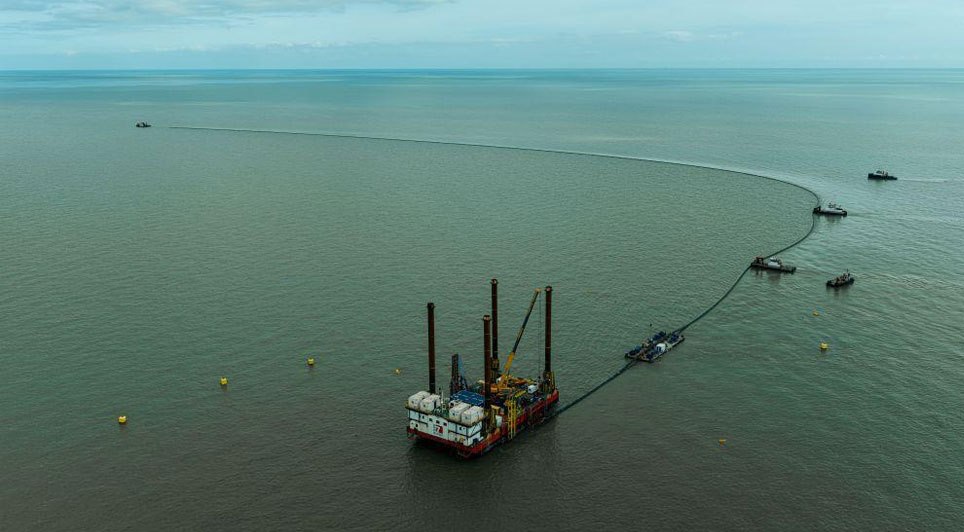
ScottishPower Renewables has completed a record-setting subsea drilling and duct pull-in operation at its £4 billion East Anglia Two offshore wind farm, marking a global engineering first.
The milestone involved installing two cable ducts that will shield the high-voltage export cables carrying clean power from the 960MW development to shore.
Executed using Horizontal Directional Drilling (HDD) beneath the Suffolk coastline and seabed, the operation utilised the world's longest continuous single sections of extruded polyethylene (PE) ducts. Each duct measures just under 1,800 metres in length and 800mm in diameter, creating the UK's largest electricity transmission landfall of its kind when those dimensions are combined. The length is comparable to Edinburgh's Royal Mile (from the Castle to Holyrood Palace) and to the stretch of the Thames from the London Eye to Tate Modern.
Ross Ovens, ScottishPower Renewables' Managing Director for Offshore said: "The completion of this colossal HDD, which is three times the length of our other East Anglia projects, is a huge achievement – quite literally – and a major milestone as we progress construction of our third windfarm in the region. Our priority is always to deliver our clean energy projects, and all the benefits they bring, in a responsible and sensitive way that is mindful of the environment and the people around us.
"Landfall works are known to be one of the most technically challenging aspects of building an offshore windfarm, but thanks to precision planning and a great partnership with our principal contactor OCU Group and duct manufacturer Pipelife, this programme has well and truly hit the mark – breaking UK and world records in the process. It's incredible."

HDD is a trenchless technique that bores deep underground to create a sub-surface route without disturbing beaches, dunes, cliffs or coastal habitats, significantly reducing environmental disruption. The method is delivered by rigs operating both onshore and offshore in tandem.
The HDD programme forms part of East Anglia Two's civil works being led by principal contractor OCU Group, supported by its subsidiary Peter McCormack & Sons, with more than 80 jobs sustained during construction.
Mike McNulty, HDD Director at OCU Group, said: "Delivering a landfall HDD of this scale is an exceptional engineering achievement, demanding meticulous planning, technical expertise and close collaboration. Successfully installing two 1,800-metre, 800mm diameter PE pipes, each in a single continuous section, is testament to the skill and commitment of everyone involved.
"We're incredibly proud to be working alongside ScottishPower Renewables and our project partners to deliver this critical infrastructure for East Anglia TWO. This milestone demonstrates what can be achieved through specialist engineering, strong partnerships and a shared commitment to delivering major energy infrastructure responsibly."
The record-breaking 1,800m x 800mm pipes were supplied by Pipelife.
Project Manager in Pipelife Norway, Martin Myhre, said: "At 1,793 meters, this is the longest pipe Pipelife Norway has ever manufactured, making it a significant milestone for us. Producing the pipe through continuous extrusion meant we could manufacture it as one uninterrupted length, without the need for welding. This eliminates welded joints, resulting in a more robust and reliable solution for this demanding application.
"The pipe's journey was also quite extraordinary. After being manufactured at our facility in Stathelle, Norway, it was transported all the way to Thorpeness in England by tow. A project of this scale takes close collaboration and careful planning throughout the entire supply chain, and we are very proud to have contributed to this record-breaking achievement."
The first export cable installation is scheduled for summer 2027, with commercial operations targeted for late 2028.
East Anglia Two will sit in the southern North Sea, around 33km from the Suffolk coast at its nearest point off Southwold and 37km from Lowestoft. With up to 960MW of capacity, it is expected to generate enough homegrown green electricity to power the equivalent of almost one million homes. The project has already channelled more than £1.5 billion into the UK supply chain.