Scotland
 UK
UK Ireland
 London


The Glenigan Construction Forecast 2026–28 signals that a clearer upturn is now expected from 2027, with high interest rates and a sluggish wider recovery keeping overall activity muted this year. The report highlights rising public sector non‑housing work from the summer as capital spending feeds through, along with renewed momentum across utilities, energy and transport infrastructure. On the private side, robust demand for prime office space and refurbishments, data centres, and logistics and warehousing is set to create opportunities, while stronger household spending should lift private housing, retail, and hotel & leisure from 2027.
Although total underlying starts (projects under £100 million) are set to edge down in 2026, Glenigan anticipates a strong rebound of 11% in 2027, driven by education, industrial, civil engineering and private housing, with an additional 4% growth in 2028. Glenigan Economics Director Allan Willen said: "While economic fundamentals are improving gradually, the translation into construction activity has been slow, with a more meaningful upturn now expected from 2027…. Developers are increasingly prioritising schemes with stronger margins or lower risk profiles, leading to a narrowing of the active pipeline."
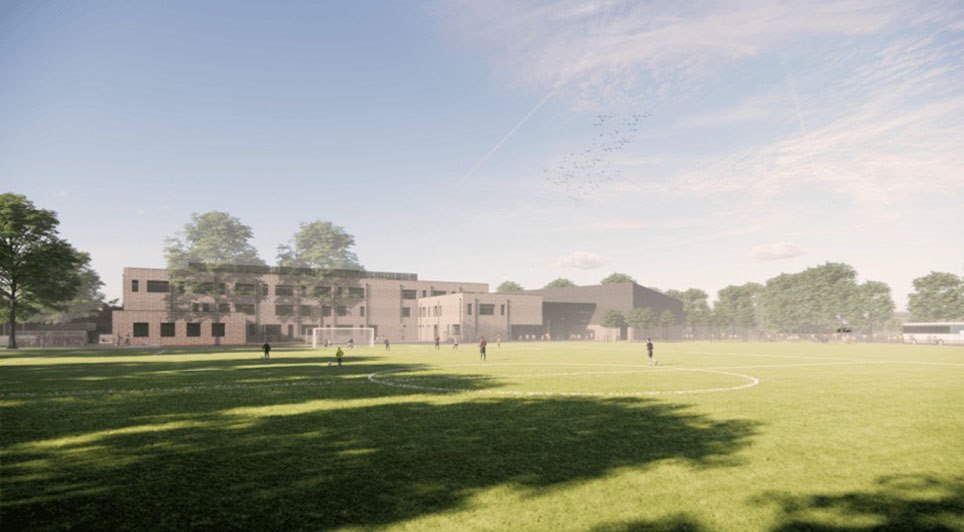
Education stands out as a major bright spot. As the School Rebuilding Programme gathers pace and RAAC remediation continues, underlying education starts are expected to rise 8% in 2026, a further 20% in 2027 to just under £7 billion, and by another 5% in 2028. Glenigan's project database points to frequent new opportunities under the programme, including Wetherby High School in West Yorkshire, where BAM Construction has been appointed design & build contractor on a £38 million rebuild due to start later this year (Project ID: 21558719). While university work is likely to remain restrained by financial pressures, activity at further education colleges is predicted to increase over the next two years.
Health construction is also set for sustained growth as more funding is released through the New Hospital Programme. Following a 9% uplift in underlying starts this year, Glenigan forecasts a further 9% rise in 2027 and 14% in 2028. Alongside new hospital developments, works to tackle the sizeable maintenance backlog and to improve building safety and resilience, plus investment in diagnostic and community care hubs, are expected to support the sector.

Civil engineering is on track for a notable upswing, with total underlying starts forecast to grow by 15% in 2027. Utilities investment is a key driver: Ofwat's £104 billion AMP8 programme for 2025–30 is set to keep water industry contractors busy, with headline schemes including the £6.84 billion White Horse Reservoir in Oxfordshire, now inviting applications to tender (Project ID: 93116493), and the £1.8 billion Anglian Water Major Infrastructure Delivery Programme, currently seeking expressions of interest (Project ID: 25596822).
Power networks and low‑carbon generation are another growth engine. National Grid plans record multi‑year capital investment of around £60–70 billion between 2026 and 2031 under the Great Grid Upgrade and other programmes, spanning overhead lines, substations and subsea links. Activity on renewables such as offshore wind, together with landmark nuclear projects Sizewell C (Project ID: 01611111) and Hinkley Point C (Project ID: 01611123), will underpin workloads.
Transport investment rounds out the civils picture. Under England's £27 billion Strategic Road Network Programme (RIS3), £8.4 billion is earmarked for maintenance and renewals through to 2031, including resurfacing and bridges. Network Rail's CP7 programme, running to 2029 and totalling £43–45 billion, is expected to generate further opportunities; a £95 million redevelopment of Liverpool Central station, where an architect has been appointed, is among schemes highlighted in Glenigan's data (Project ID: 24079403). East West Rail, Northern Powerhouse Rail (longer‑term development) and Anglia route renewals offer additional potential.
Social housing should benefit from increased government support set out in the Spending Review. After two static years, starts are forecast to rise 8% in 2027 and 4% in 2028. Adjustments to the social housing rent cap should help bring forward more schemes, while faster determinations by the Building Safety Regulator are expected to enable additional high‑rise apartment projects. Planning approvals have surged this year across much of the country, led by London, where approvals are on track to reach £1.7 billion, with strong activity also seen in Scotland, the North West, East Midlands, West Midlands, East of England and Yorkshire & the Humber.
Private housing is set to find firmer footing as interest rates ease and confidence improves. Glenigan projects underlying private housing starts will rise 13% in 2027 and 5% in 2028, supported by regulatory easing and planning reforms that should release more sites.
In offices, demand for prime, grade A space — both new‑build and refurbished — alongside the spread of data centres, has kept contractors busy. After a 24% jump last year, Glenigan expects underlying office starts to grow by a further 21% in 2026. A slowdown is anticipated in 2027 amid political uncertainty and higher delivery costs, particularly for data centres, before a steadier return to growth in 2028.
Industrial activity has been hampered by cost pressures, high borrowing costs and weaker sentiment among manufacturers, although logistics and distribution remain resilient. Following an expected 9% drop in starts this year, Glenigan forecasts a 16% rise in 2027 and an additional 5% in 2028, led by continued demand for warehouse space linked to e‑commerce and evolving supply chains.
Hotel & leisure is poised for recovery after a difficult 2026, when rising wage and fuel costs and the impact of conflict in the Middle East weighed on confidence and starts are set to fall 12%. Glenigan predicts an 11% rebound in 2027, with little further change in 2028. The trend in approvals is encouraging: underlying hotel & leisure planning consents rose 56% in the three months to April versus a year earlier. A flagship scheme now approved, the Universal UK Resort theme park in Bedford, represents £6.3 billion of investment over the next five years (Project ID: 23398445).
Retail construction, which slumped 28% last year, is stabilising in 2026 and is forecast to climb 10% in 2027 on the back of firmer consumer spending. Supermarket expansion — notably among the budget chains — is expected to lead the turnaround; in the first 10 days of June alone, Glenigan recorded 31 separate Lidl GB projects progressing through various stages.
Overall, momentum is set to build into 2027 and strengthen further in 2028. Early gains are being driven by public investment and infrastructure, with private sector appetite gradually returning to broaden the pipeline. While near‑term challenges persist, improving fundamentals and targeted funding point to a more resilient market and a widening spread of opportunities across both core and emerging sectors.