Scotland
 UK
 Ireland
 London


Kier has published a report examining how recommendations in the Construction Playbook are being applied to industrialised delivery across major public sector programmes.
Lessons from the Construction Playbook: Industrialisation in Action considers how longer-term contracts, standardisation, outcome-based specifications and early supply chain involvement can improve productivity, quality and programme certainty.
The company recommends wider use of standardised outcome measures, closer alignment between customers and supply chains, and greater emphasis on programme-level delivery models that support industrialisation and continuous improvement. The report comes as skills shortages and cost uncertainty continue to challenge public infrastructure delivery.
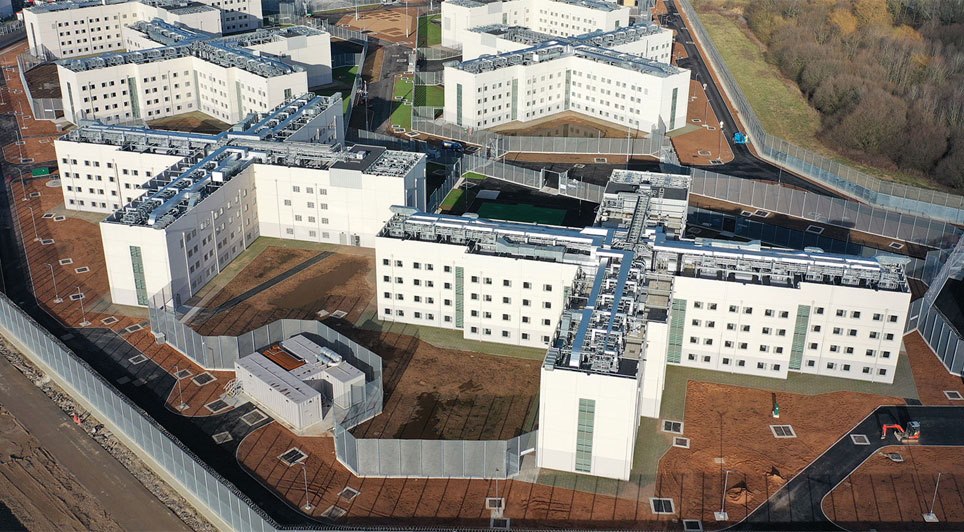
Its findings draw on Kier's experience of government programmes including the Ministry of Justice's New Prison Programme, the NHS New Hospital Programme, the Defence Infrastructure Organisation's Single Living Accommodation Programme and the Department for Education's construction frameworks.
Kier's analysis reports improvements of 47% in productivity, 40% in quality and 15% in delivery certainty from industrialised delivery. It also identifies delivery 22% faster than traditional, non-systemised approaches.

The report says 74% of prison houseblock design and 60% of overall project design were standardised. It also records 43% fewer technical queries per 100 documents, a 41% reduction in construction waste per 100 square metres and 15% fewer quality issues per 100 square metres.
Embodied carbon in precast concrete fell by 14.9% compared with the baseline from Fosse Way, the Ministry of Justice's previously completed prison. Digital tracking across prison projects supported a 99.3% precast quality rate, while all projects in the New Prison Programme were reported to have been completed to budget and schedule.
Kier argues that project performance should be assessed using more than traditional cost-based productivity measures alone. It says certainty, quality, waste reduction, design efficiency, carbon performance and workforce stability can provide a fuller picture.
Andrew Dewdney, head of industrialisation at Kier, said: "When the Construction Playbook was published in 2020, it set out a clear vision for transforming how public sector projects and programmes are delivered. Five years on, the industry is increasingly asking what evidence exists that those principles work in practice. What we've found is that the greatest benefits come when industrialisation is viewed as more than a construction methodology. It is about creating the conditions for continuous improvement through repeatable requirements, integrated supply chains and long-term programme thinking. The evidence suggests it can play a critical role in helping clients looking at critical infrastructure investments improve productivity, certainty and value across repeatable programmes of work."
Dapo Obatusin, deputy director of Capital Construction Delivery at the MoJ Property Directorate, added: "Industrialised construction is central to our approach to delivering the prison estate we need. Kier's report reinforces the case for this model, demonstrating how innovation and practical delivery experience can improve productivity, quality and certainty. By sharing these insights and lessons, Kier is helping advance a way of building that is essential to delivering at the scale required and securing better value for the public."