Scotland
 UK
UK Ireland
 London

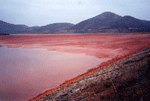
Scientists at the University of Glasgow have found a way to turn a toxic industrial waste product into a water de-contaminator.
The chemistry team, working with Indian partners The Energy and Resources Institute, have found "encouraging signs" that a substance called red mud could be carbonised to make it safer. The resulting magnetic material could then remove heavy metals including lead and copper from water.
But they do not yet know whether the idea could be rolled out on a large scale.
Red mud is a byproduct of the Bayer process, an industrial procedure used in the production of aluminium.

Worldwide, about 120 million tonnes of dangerous highly alkaline red mud are created annually.
It is usually kept in large open-air holding ponds but this led to disaster in 2010 when a million cubic metres of the substance flooded Hungarian countryside, killing nine people.
Dr Justin Hargreaves, Senior Lecturer in Chemistry, said: "We’re still some way from scaling the process up to industrial levels but we’re keen to explore the possibilities. By using red mud as a catalyst to crack methane, which liberates hydrogen, we've reduced the iron oxide in the mud to iron metal or iron carbide which are coated with carbon. This material is magnetic, so when it is added to water contaminated with metals, it can be used to remove the contaminants. Carbonisation also reduces the pH of the mud much more effectively than current methods, which involve adding acid to the mud. This makes carbonised mud less of a handling hazard."
(NE)